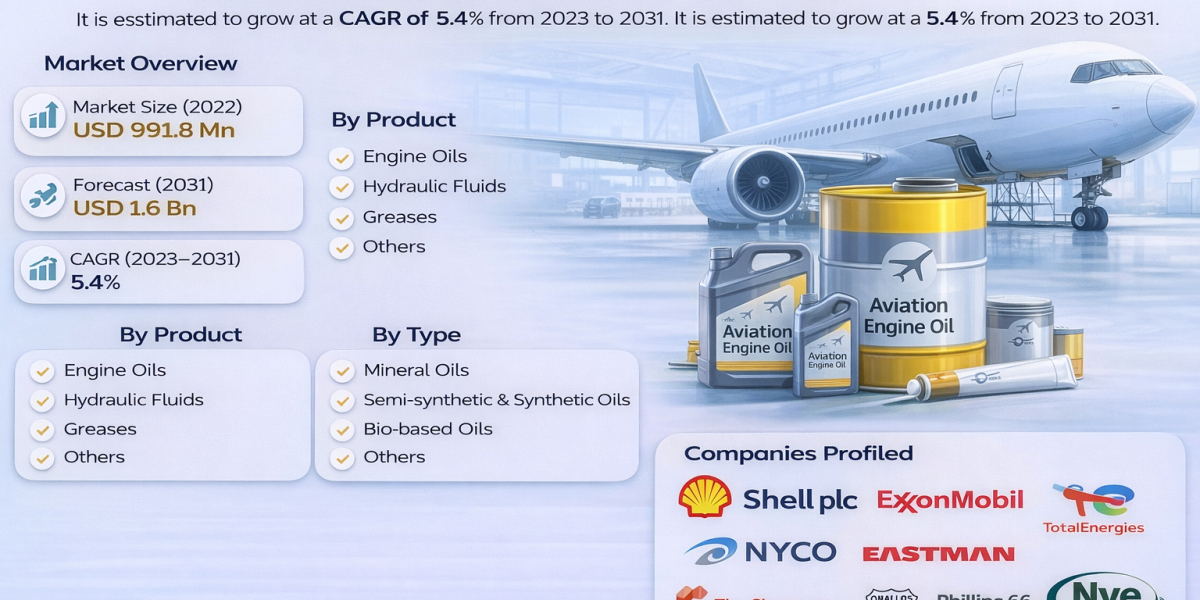

The global aviation lubricants market was valued at USD 991.8 million in 2022 and is projected to reach USD 1.6 billion by the end of 2031. Driven by the steady recovery of air travel, rising aircraft fleet size, and growing demand for high-performance lubricants to enhance engine efficiency and reliability, the market is expected to expand at a CAGR of 5.4% from 2023 to 2031. This growth reflects increasing maintenance activities across commercial, military, and general aviation segments worldwide.
The aviation lubricants market size is driven by increase in adoption of air travel and rise in air cargo activities. Changes in lifestyles of people and the availability of accessible and affordable air travel are boosting air traffic. Stakeholders in the global aviation lubricants industry are capitalizing on this trend and targeting end-users who are increasing the strength of their commercial fleets.
Transform Your Strategy: Explore In-Depth Data – Sample Available! https://www.transparencymarketresearch.com/sample/sample.php?flag=S&rep_id=41393
Aviation lubricants are used in the aviation sector to ensure the proper functioning and maintenance of aircraft engines and other mechanical components. These lubricants are specifically designed to meet the demanding operating conditions of the sector.
Market Segmentation
By Service Type (End-User)
- Aftermarket (MRO): Holds the dominant share (nearly 98% of consumption). As the global fleet ages, the demand for Maintenance, Repair, and Overhaul (MRO) services remains the primary revenue driver.
- OEM (Original Equipment Manufacturer): Focuses on "first-fill" requirements for new aircraft deliveries, which are surging due to massive commercial backlogs.
By Sourcing Type (Technology)
- Mineral-Based: Preferred for cost-effectiveness and compatibility with older seals, though its market share is slowly being challenged by advanced alternatives.
- Synthetic: The fastest-growing segment. Synthetic lubricants offer superior thermal stability, oxidation resistance, and longer drain intervals, making them essential for modern jet engines.
- Bio-Based: An emerging segment driven by environmental mandates and the push for "green" aviation solutions.
By Application
- Engine: Dominates the market (over 55% share). Engine oils must handle the most extreme temperatures and pressures within the turbine.
- Hydraulic Systems: Critical for flight control surfaces and landing gear operation.
- Landing Gear & Airframe: Relies on specialized greases to prevent wear during high-impact landings and take-offs.
By Industry Vertical (Platform)
- Commercial Aviation: The largest segment, driven by passenger traffic and cargo expansion.
- Military Aviation: Focuses on high-performance lubricants for fighter jets and transport aircraft.
- Business & General Aviation: Includes private jets and piston-engine planes.
- Unmanned Aerial Vehicles (UAVs): A high-growth niche fuelled by defense and commercial drone adoption.
Regional Analysis
Region | Market Dynamics |
North America | The largest market (approx. 31.5% - 38% share). Home to major OEMs (Boeing) and leading airlines. Focuses heavily on synthetic and high-performance lubricants. |
Asia-Pacific | The fastest-growing region. Driven by fleet expansion in China and India, government initiatives (like the Belt and Road Initiative), and a surge in low-cost carriers (LCCs). |
Europe | Centered on sustainability. Strict environmental regulations (EASA/ReFuelEU) are pushing the market toward bio-based and eco-friendly lubricants. |
Middle East & Africa | Growing as a global transit hub, with airlines like Emirates and Qatar Airways expanding long-haul fleets. |
Market Drivers and Challenges
Drivers
- Rising Air Passenger Traffic: With global passengers expected to exceed 5.2 billion annually by 2026, aircraft utilization is at an all-time high.
- Next-Gen Engine Technology: Engines like the GE9X operate at core temperatures up to 2,000 Kelvin, requiring High Thermal Stability (HTS) oils.
- Fleet Modernization: Airlines are replacing older planes with fuel-efficient models that require specific advanced lubricants.
Challenges
- Volatile Crude Oil Prices: Fluctuations in feedstock costs disrupt the pricing of mineral-based lubricants.
- Stringent Regulatory Standards: Frequent updates from FAA and EASA require constant R&D to ensure compliance.
- Contamination Risks: Maintenance errors or poor storage can lead to lubricant degradation, risking engine failure.
Market Trends & Future Outlook
- Sustainable Aviation Fuel (SAF) Compatibility: Lubricants are being reformulated to ensure they do not react poorly with the chemical markers of bio-synthetic fuels.
- Digital Oil Monitoring: A shift toward predictive maintenance, where sensors analyse oil condition in real-time to prevent "carbon coking" and wear.
- Consolidation: Large players are acquiring specialty firms (e.g., Fuchs acquiring LUBCON) to gain access to niche aerospace technologies.
Competitive Landscape
The market is highly consolidated, with five major players controlling the majority of the global share. These companies maintain dominance through rigorous OEM approvals and global distribution networks.
Elevate Your Business Strategy! Purchase the Report for Market-Driven Insights: https://www.transparencymarketresearch.com/checkout.php?rep_id=41393<ype=S
Key Market Players:
- ExxonMobil: Known for the "Mobil Jet Oil" series, a staple in commercial aviation.
- Shell Aviation: A leader in "AeroShell" products and a pioneer in carbon-neutral lubricant initiatives.
- Eastman Chemical Company: Their Turbo Oil 2197 is a global standard for high-cycle airlines.
- Total Energies: Focuses on comprehensive solutions for both civil and military sectors.
- NYCO: A major specialist in synthetic esters and military-grade lubricants.
Recent Developments
- January 2024: Air Europa signed a long-term agreement with Shell Aviation to supply Aero Shell lubricants for its Boeing 737 and 787 fleets.
- July 2023: Shell launched a new approach to address lifecycle carbon emissions in its lubricant portfolio.
- 2025 Market Milestone: The industry reached a critical juncture where lubricants must now prove compatibility with SAF production, which scaled to 175 million gallons this year.
About Transparency Market Research
Transparency Market Research, a global market research company registered at Wilmington, Delaware, United States, provides custom research and consulting services. Our exclusive blend of quantitative forecasting and trends analysis provides forward-looking insights for thousands of decision makers. Our experienced team of Analysts, Researchers, and Consultants use proprietary data sources and various tools & techniques to gather and analyses information.
Our data repository is continuously updated and revised by a team of research experts, so that it always reflects the latest trends and information. With a broad research and analysis capability, Transparency Market Research employs rigorous primary and secondary research techniques in developing distinctive data sets and research material for business reports.
Contact:
Transparency Market Research Inc.
CORPORATE HEADQUARTER DOWNTOWN,
1000 N. West Street,
Suite 1200, Wilmington, Delaware 19801 USA
Tel: +1-518-618-1030
USA – Canada Toll Free: 866-552-3453
Website: https://www.transparencymarketresearch.com
Email: sales@transparencymarketresearch.com