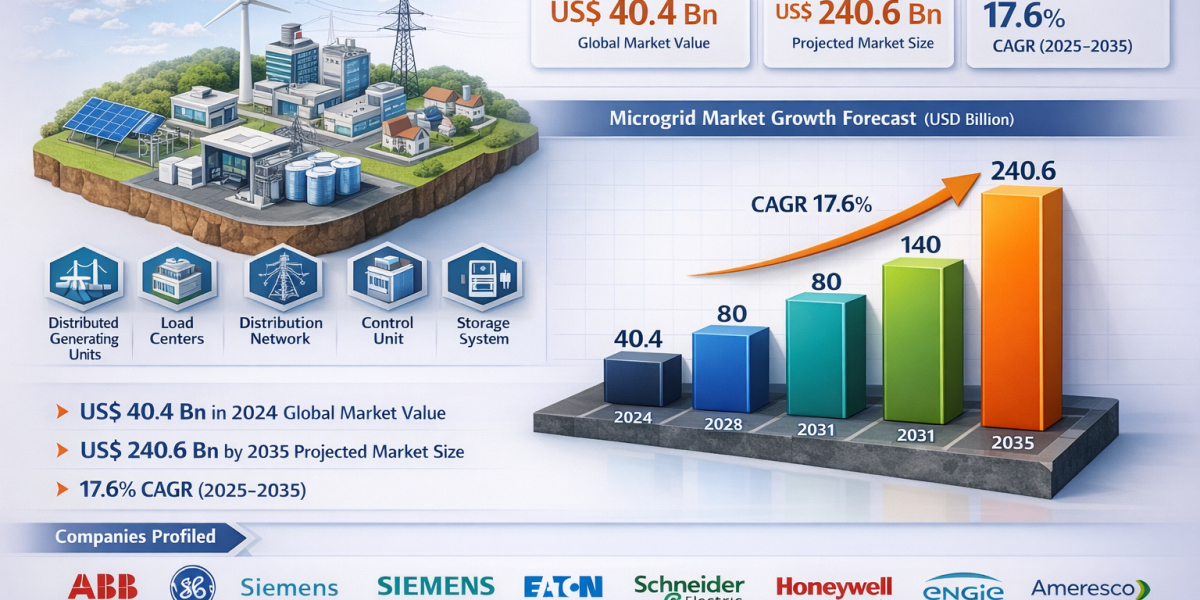

The global microgrid market was valued at USD 40.4 Bn in 2024 and is projected to reach USD 240.6 Bn by the end of 2035, expanding at a strong CAGR of 17.6% from 2025 to 2035. Growth is driven by rising demand for reliable and resilient power supply, increasing integration of renewable energy sources, and growing investments in decentralized energy systems. Supportive government initiatives, rural electrification programs, and the need for energy security across commercial, industrial, and remote areas are further accelerating market expansion through 2035.
A microgrid is a type of energy network within a locality that is capable of operating in tandem with a major power grid or independently. A microgrid basically integrates distributed energy resources such as wind turbines, solar panels, backup generators, and energy storage. As the energy landscape has changed today, microgrids have become a smart way to bolster energy efficiency, security, and sustainability, particularly in areas with grid reliability issues or increased use of renewables.
Dive Deeper into Data: Get Your In-Depth Sample Now! https://www.transparencymarketresearch.com/sample/sample.php?flag=S&rep_id=236
Microgrids help with cost optimization through load balancing and onsite offtake of renewable energy, thereby helping organizations save on their energy expense. Microgrids aid organizations achieve their sustainability goals through maximizing renewable energy use and cutting down on carbon emissions, rendering these systems the foundation of corporate ESG efforts and formal decarbonization plans.
Market Segmentation
To understand the complexity of this decade-long forecast, we must look at how the market is partitioned:
By Service Type
- Engineering and Design: High initial demand as projects move from conceptualization to execution.
- Software as a Service (MaaS): The fastest-growing sub-segment, offering cloud-based energy management.
- Monitoring and Control: Essential for real-time load balancing and grid synchronization.
- Operation and Maintenance (O&M): Gaining traction as the installed base of microgrids ages.
By Sourcing Type (Connectivity)
- Grid-Connected: Dominates the market (~65% share) due to its role in urban grid modernization and peak shaving.
- Remote / Off-Grid: The fastest-growing segment (CAGR >20%) as it serves the 700+ million people globally who lack reliable grid access.
- Hybrid: Increasing adoption in regions with intermittent grid stability.
By Application
- Campus / Institutional: Historically the largest segment (universities, hospitals).
- Community & Utility: Growing as utilities use microgrids to defer expensive transmission upgrades.
- Remote Islands: Critical for reducing dependency on expensive, imported diesel.
- Military & Defense: Driven by the need for "mission-critical" energy security.
By Industry Vertical
- Commercial & Industrial (C&I): Leading revenue generator as factories and data centers seek cost stability.
- Healthcare: High priority due to the life-safety implications of power outages.
- Government & Education: Focused on sustainability mandates and disaster relief hubs.
- Utility: Utilizing decentralized assets to manage high-density EV charging and renewable influx.
Regional Analysis
Region | Market Dynamics |
North America | Currently the largest market share holder (~35-38%). Driven by aging infrastructure, extreme weather resilience, and significant federal funding (e.g., U.S. DOE initiatives). |
Asia-Pacific | The fastest-growing region (~21% CAGR). Propelled by rapid rural electrification in India, China, and Southeast Asia, alongside Japan's push for distributed energy. |
Europe | Focused on "Smart City" integration and aggressive decarbonization goals. Strong growth in the UK, Germany, and Nordic regions. |
Middle East & Africa | Rapidly adopting solar microgrids to bypass the need for traditional, expensive national grid expansions in remote areas. |
Market Drivers and Challenges
Drivers
- Energy Resilience: Increasing frequency of climate-induced grid failures (wildfires, hurricanes).
- Decarbonization: Corporate and national "Net-Zero" targets driving renewable integration.
- Rural Electrification: Microgrids are the most cost-effective way to bring power to underserved populations.
- Cost Efficiency: Falling prices for lithium-ion and flow batteries.
Challenges
- High Upfront CAPEX: Despite falling costs, initial investment remains a barrier for smaller enterprises.
- Regulatory Hurdles: Lack of standardized "interconnection" rules between microgrids and traditional utilities.
- Cybersecurity: As microgrids become more digital, they become potential targets for cyberattacks.
Market Trends
- AI & GenAI Integration: Using predictive analytics to forecast weather patterns and optimize energy trading in real-time.
- Microgrid-as-a-Service (MaaS): A shift from ownership to subscription models, allowing companies to avoid upfront capital costs.
- Green Hydrogen: The emergence of hydrogen-based microgrids for long-duration storage in industrial sectors.
- EV Integration: Using electric vehicle fleets as "mobile batteries" (V2G - Vehicle to Grid) within a microgrid ecosystem.
Future Outlook
The next decade will see the microgrid evolve from a "backup system" to the primary building block of the smart grid. We expect a massive shift toward DC Microgrids—specifically for data centers and EV charging hubs—to eliminate conversion losses. By 2035, the distinction between "the grid" and "a microgrid" will likely blur, as decentralized nodes become the standard architecture for modern power distribution.
Key Market Study Points
- The 1 MW – 5 MW sweet spot: This capacity range currently dominates the C&I sector.
- Software is King: While hardware (batteries/panels) makes up the bulk of current revenue, software margins are significantly higher and driving long-term value.
- Policy Support: Government grants (like the USD 72.8M DOE loan for tribal microgrids) are the primary catalysts for large-scale renewable integration.
Buy this Premium Research Report: https://www.transparencymarketresearch.com/checkout.php?rep_id=236<ype=S
Competitive Landscape
The market is highly competitive, led by diversified industrial conglomerates and specialized tech firms:
- Market Leaders: Schneider Electric, Siemens Energy, ABB Ltd, General Electric, and Eaton.
- Challengers: S&C Electric Company, Honeywell, and Tesla (Energy).
- Regional Specialists: Tata Power (India), Adani Energy, and various European utility-tech startups.
Recent Developments
- ABB & VoltaGrid (Nov 2025): Partnered to deliver grid stabilization technology specifically for AI data centers in the U.S.
- India’s Green Hydrogen Push (April 2024): Advait Infratech launched the nation’s first green hydrogen microgrid, generating 50kg of high-purity hydrogen daily.
- US DOE AI4IX (2025): The "Artificial Intelligence for Interconnection" initiative was launched with USD 30 million to accelerate the integration of microgrids into the national grid using AI.
About Transparency Market Research
Transparency Market Research, a global market research company registered at Wilmington, Delaware, United States, provides custom research and consulting services. Our exclusive blend of quantitative forecasting and trends analysis provides forward-looking insights for thousands of decision makers. Our experienced team of Analysts, Researchers, and Consultants use proprietary data sources and various tools & techniques to gather and analyses information.
Our data repository is continuously updated and revised by a team of research experts, so that it always reflects the latest trends and information. With a broad research and analysis capability, Transparency Market Research employs rigorous primary and secondary research techniques in developing distinctive data sets and research material for business reports.
Contact:
Transparency Market Research Inc.
CORPORATE HEADQUARTER DOWNTOWN,
1000 N. West Street,
Suite 1200, Wilmington, Delaware 19801 USA
Tel: +1-518-618-1030
USA – Canada Toll Free: 866-552-3453
Website: https://www.transparencymarketresearch.com
Email: sales@transparencymarketresearch.com