
Natural Food Colors Market Outlook
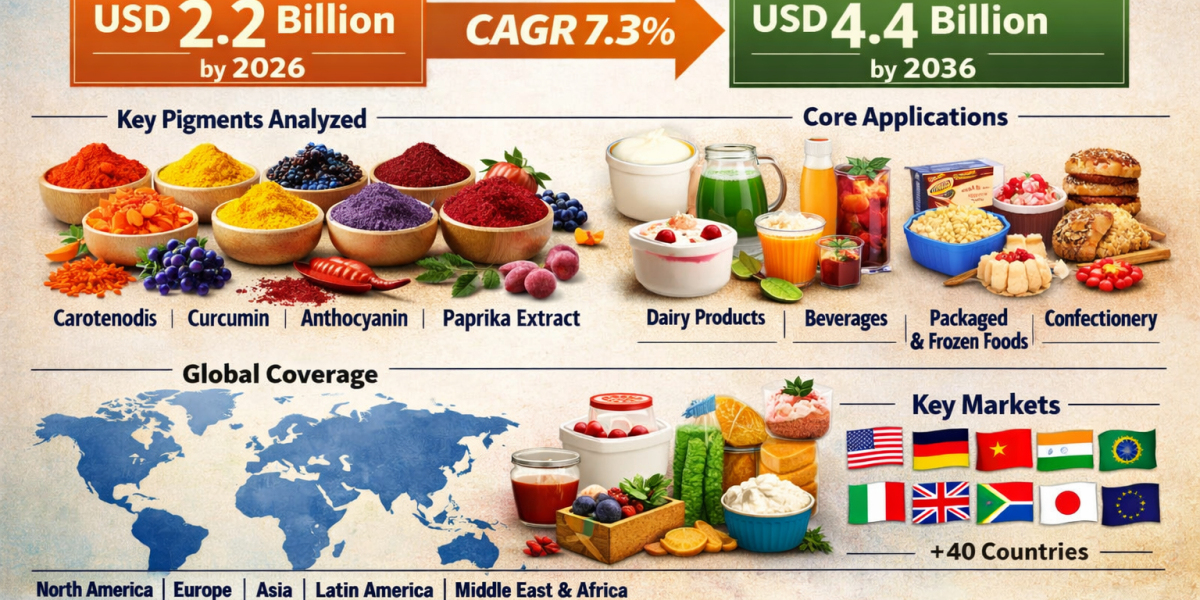
The global natural food colors market is entering a high-growth phase as food and beverage manufacturers accelerate the shift away from synthetic dyes toward plant-based, mineral-based, and fermentation-derived pigments. Valued at USD 2.2 billion in 2026, the market is projected to reach USD 4.4 billion by 2036, expanding at a CAGR of 7.3% over the forecast period.
This expansion is being fueled by a convergence of factors: rising consumer scrutiny of ingredient labels, tightening regulations on artificial additives, and the rapid growth of natural, organic, and better-for-you food categories. Across bakery, confectionery, dairy, beverages, and processed foods, visual appeal remains a decisive purchase driver—yet consumers increasingly expect vibrant colors without synthetic chemistry.
Clean Labels Push Natural Pigments Into the Mainstream
Natural food colors derived from beetroot, turmeric, paprika, annatto, spirulina, red cabbage, and carotenoids are now widely adopted in juices, flavored waters, yogurts, gummies, dairy alternatives, and savory snacks. These pigments help brands maintain shelf appeal while aligning with transparency and wellness positioning.
Discover Growth Opportunities in the Market - Get Your Sample Report Now : https://www.futuremarketinsights.com/reports/brochure/rep-gb-35
At the same time, advances in extraction, stabilization, and encapsulation technologies are overcoming long-standing performance gaps. Improved resistance to heat, light, and pH variation is enabling natural colors to move beyond niche products into large-scale industrial processing and global product portfolios.
Market Snapshot
- Market Value (2026): USD 2.2 billion
- Forecast Value (2036): USD 4.4 billion
- Forecast CAGR (2026–2036): 7.3%
- Leading Pigment Segment: Carotenoids (~36% share)
- Largest Application Segment: Beverages (~38.8% share)
- Key Growth Regions: India, China, North America, Western Europe
Carotenoids Dominate Investment Focus
Among pigment types, carotenoids are the largest and most attractive investment segment, accounting for approximately 35.8% of global demand by 2026. Beta-carotene, lutein, and lycopene deliver stable yellow-to-orange hues across dairy, snacks, bakery, and beverages.
Beyond color strength, carotenoids offer an added nutritional halo linked to antioxidant and eye-health benefits—an advantage that resonates strongly with wellness-oriented consumers. Ingredient suppliers continue to expand carotenoid portfolios with improved dispersion and shelf-life performance, making them a preferred choice for clean-label reformulation.
Beverages Lead Application Demand
Beverages represent the single largest end-use segment, contributing nearly 38.8% of total market revenue. From juices and flavored waters to functional and botanical drinks, color plays a critical role in signaling freshness, flavor, and health benefits.
As consumers increasingly reject artificial dyes, beverage brands are adopting fruit-, vegetable-, and algae-derived pigments that align with claims around vitamins, antioxidants, and plant-based nutrition. Ready-to-use liquid color systems are enabling faster reformulation while maintaining shade consistency and regulatory compliance.
Regional Outlook: Asia Emerges as a Growth Engine
While North America and Western Europe remain mature markets driven by strong clean-label adoption and strict food safety standards, Asia is emerging as the fastest-growing region.
- India leads global growth with an 8.5% CAGR, supported by abundant botanical resources such as turmeric, marigold, annatto, and beetroot, alongside expanding food processing capacity.
- China follows closely at 8.3% CAGR, driven by rapid reformulation of packaged foods, functional beverages, and dairy products.
- The United States grows at 8.1% CAGR, as major brands remove synthetic dyes from mainstream products and retailers increasingly favor natural ingredient lists.
- Germany (7.7%) and France (7.4%) benefit from premium food positioning, fermentation-based pigment innovation, and strong regulatory alignment.
Supply Chain Challenges Drive Innovation
Despite robust momentum, the industry faces challenges tied to raw material variability, seasonal crop yields, and higher production costs compared with synthetic colors. Color consistency and formulation stability remain technical hurdles, particularly for heat-processed or long-shelf-life products.
In response, manufacturers are investing in:
- Diversified botanical sourcing across geographies
- Fermentation-based color production for scalability and consistency
- Vertically integrated supply chains to stabilize pricing and availability
These strategies are strengthening long-term supply security while supporting global expansion.
Competitive Landscape Centers on Performance and Compliance
The natural food colors market is led by global ingredient specialists such as Sensient Technologies, Oterra, GNT Group, Döhler, Naturex, DDW The Color House, Kalsec, and LycoRed, supported by a wide base of regional suppliers.
Competition increasingly revolves around three factors: access to diverse raw materials, performance across processing conditions, and global regulatory compliance. Companies that can deliver stable shades, clean taste profiles, and multi-region approval are securing long-term partnerships with multinational food brands.
Outlook Through 2036
As artificial dyes continue to lose acceptance, natural food colors are becoming a core component of product design rather than a niche alternative. With visual appeal, ingredient transparency, and regulatory alignment converging, the market is set to double in value by 2036, positioning natural pigments as a strategic growth pillar for the global food and beverage industry.
Why FMI :https://www.futuremarketinsights.com/why-fmi
Have a Look at Related Research Reports on the Food & Beverage Domain:
Natural Food Colors Market : https://www.futuremarketinsights.com/reports/global-natural-food-colours-market
Stevia Market https://www.futuremarketinsights.com/reports/global-stevia-market
Convenience Food Market : https://www.futuremarketinsights.com/reports/global-convenience-foods-market