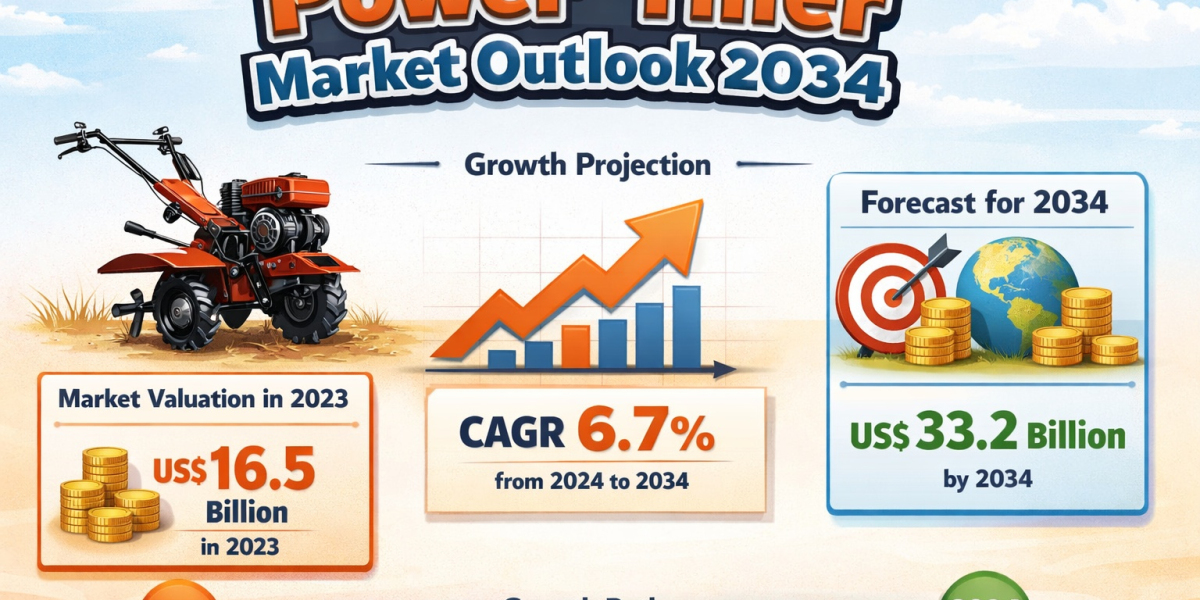

The global power tiller market is witnessing robust performance as agriculture undergoes a profound transformation driven by smart technologies, sustainability goals, and the urgent need to improve productivity. Valued at approximately US$ 17.2 Bn in 2024, the market is projected to surpass US$ 34.8 Bn by 2035, expanding at a CAGR of around 6.5% during the forecast period. This growth reflects structural changes in global farming systems, particularly in developing economies where small and marginal farmers form the backbone of agricultural output.
Power tillers, also known as walking tractors or hand tractors, are versatile agricultural machines primarily used for tillage, soil preparation, weeding, puddling in paddy fields, and small-scale hauling. Their compact size, cost efficiency, and adaptability make them ideal for fragmented landholdings where large tractors are impractical.
As agricultural stakeholders increasingly prioritize yield optimization, labor efficiency, and environmental stewardship, the power tiller market is evolving into a critical component of the global farm mechanization ecosystem.
Key Growth Catalysts
Rising Mechanization in Developing Economies
In regions such as South Asia, Southeast Asia, and parts of Africa, farm sizes are typically small and irregularly shaped. Large tractors are often unaffordable and inefficient in such settings. Power tillers provide an economically viable alternative, offering:
Maneuverability in narrow fields
Lower fuel consumption
Reduced maintenance costs
Multi-functional applications
Governments in countries like India, Bangladesh, and Vietnam are actively promoting mechanization through subsidies, credit schemes, and cooperative ownership models. These initiatives are significantly boosting adoption rates.
Labor Shortages and Rural Migration
Urban migration has reduced the availability of agricultural labor in many rural regions. As labor costs rise, farmers increasingly rely on mechanized solutions to maintain productivity. Power tillers help mitigate workforce shortages by automating labor-intensive tasks such as soil turning and weed control.
Expansion of Horticulture and Specialty Farming
Beyond traditional crop farming, horticulture, floriculture, and organic farming sectors are expanding rapidly. Power tillers are particularly suited for vegetable farms, orchards, vineyards, and greenhouse operations where precision and flexibility are essential.
Technological Advancements Transforming the Market
Electrification and Sustainable Engineering
Environmental concerns and emission regulations are pushing manufacturers toward cleaner energy solutions. Electric and battery-powered tillers are emerging as viable alternatives to diesel models, offering:
Lower greenhouse gas emissions
Reduced noise pollution
Minimal vibration
Lower operating costs over time
Companies such as Honda Motor Co., Ltd. are investing heavily in fuel-efficient and environmentally compliant engines for compact agricultural equipment.
Electrification is particularly attractive in regions with expanding rural electrification infrastructure and growing awareness of sustainable farming practices.
Integration of Smart Technologies
Modern power tillers are increasingly equipped with advanced features such as:
Digital engine monitoring systems
GPS-based field mapping
IoT-enabled diagnostics
Automated depth control
These innovations allow farmers to optimize soil preparation and monitor machine performance in real time. Global agricultural machinery leaders like KUBOTA Corporation are integrating precision farming capabilities into compact equipment to enhance efficiency and user experience.
Improved Ergonomics and Safety
Manufacturers are focusing on operator comfort and safety by introducing:
Adjustable handlebars
Anti-slip controls
Enhanced braking systems
Shock-absorbing frames
Such improvements make power tillers more accessible to women farmers and aging rural populations.
Market Segmentation Analysis
By Product Type
Front-Tine Tillers – Suitable for light-duty gardening and landscaping
Rear-Tine Tillers – Designed for heavy-duty agricultural tillage
Mini Tillers – Compact models tailored for small gardens and specialty crops
Rear-tine tillers hold a dominant market share due to their superior traction and deeper soil penetration capabilities.
By Fuel Type
Diesel
Petrol
Electric
Hybrid
Diesel-powered tillers currently lead the market, particularly in Asia Pacific. However, electric and hybrid variants are projected to register the fastest growth.
By Horsepower Range
Below 5 HP
5–10 HP
10–20 HP
Above 20 HP
The 10–20 HP segment accounts for a substantial share, striking a balance between power and affordability.
By Application
Agriculture
Horticulture
Landscaping
Forestry
Agriculture remains the primary application segment, though landscaping demand is growing in developed markets.
Regional Landscape
Asia Pacific: Market Leader
Asia Pacific dominates the global power tiller market due to its vast agricultural base and high concentration of smallholder farms. Countries like India and China continue to lead in production and consumption.
Major players such as V.S.T. Tillers Tractors Ltd. have expanded product portfolios to meet diverse regional requirements, from wetland paddy cultivation to dryland farming.
North America
In North America, demand is driven largely by landscaping services, organic farming, and hobby agriculture. Deere & Company provides compact mechanization solutions catering to small-scale farmers and residential users.
Europe
Europe’s emphasis on sustainability and emission control has accelerated the shift toward eco-friendly tillers. Electrification trends are especially strong in countries promoting green agricultural policies.
Middle East & Africa
Mechanization efforts aimed at enhancing food security are gradually increasing power tiller adoption, particularly in Sub-Saharan Africa.
Latin America
Growing commercial farming activities and export-oriented agriculture are supporting market expansion in Brazil, Argentina, and neighboring countries.
Competitive Environment
The power tiller market is moderately fragmented, with global and regional manufacturers competing through innovation, pricing strategies, and distribution strength.
Prominent companies include:
Greaves Cotton Limited
Bucher Industries AG
Tirth Agro Technology Private Limited
Kamco
Strategic initiatives among these players focus on:
Expanding rural dealer networks
Investing in R&D
Developing electric and hybrid variants
Enhancing after-sales services
Entering emerging markets
Market Challenges
Despite strong growth prospects, several challenges could restrain expansion:
High Initial Investment Costs – Small farmers may struggle with upfront expenses.
Limited Technical Expertise – Training is essential for optimal usage and maintenance.
Infrastructure Constraints – Inadequate service and spare part availability in remote areas.
Seasonal Demand Fluctuations – Agricultural cycles impact sales volumes.
Addressing these barriers through policy support and financial innovation will be critical.
Emerging Opportunities
Rental and Sharing Models
Agricultural equipment rental platforms are gaining popularity, allowing farmers to access mechanization without full ownership costs.
Digital Financing Solutions
Fintech-enabled microloans and pay-per-use models are improving affordability and encouraging adoption.
Export Potential
Asian manufacturers are leveraging competitive pricing to expand exports to Africa and Southeast Asia.
Climate-Resilient Farming
Power tillers equipped with adaptive soil management features can support climate-resilient agricultural practices, improving soil aeration and moisture retention.
Future Outlook
Over the next decade, the power tiller market is expected to witness:
Greater electrification
Integration with precision agriculture technologies
Increased participation of women and youth farmers
Enhanced sustainability standards
Growth in emerging economies
Manufacturers that successfully blend affordability, innovation, and sustainability will secure long-term competitive advantages.
Conclusion
The global power tiller market is experiencing performance-driven growth as agriculture transitions toward smart, sustainable, and mechanized practices. With rising food demand, labor constraints, and technological advancements shaping industry dynamics, power tillers are becoming indispensable tools for modern farming systems. Continued innovation, policy support, and expanding access to financing will determine the pace of future expansion.